

Field Notes From the Edge
Track five core habits. Reflect each morning and night. Build direction through repetition… not motivation.
A FREE 90-day structure for those who want to show up, not just think about it.
A Quick Note on Links
As an Amazon Associate I earn from qualifying purchases.
This helps me create more class content for you to get inspired by.
Please Note
Outdoor activities involve risk. The information on this site is for general guidance only and should not replace proper training, manufacturer instructions, local laws, or your own judgement. Always use equipment safely and responsibly.
A dead phone outdoors is annoying at best.
At worst, it’s your map gone, weather forecast gone, train ticket gone, emergency contact gone, camera gone, and your smug “I’ll just use my phone” navigation plan suddenly looking a bit fragile.
Power banks are not exciting outdoor gear. They do not feel rugged. They do not make you look adventurous. They just sit in your bag doing nothing until the exact moment they become one of the most useful things you packed.
For UK hikes, campsites, festivals, wild camps and long days outside, a compact power bank is a simple way to keep your phone, head torch, earbuds, GPS watch or small lantern alive.
This guide covers the best power banks for hiking, camping and keeping your phone alive outdoors, plus what capacity you actually need.
Quick Picks: Best Power Banks for Hiking and Camping
Best overall power bank: Anker 313 Power Bank PowerCore 10K
Best lightweight hiking power bank: Nitecore NB10000 Gen 3
Best budget power bank: INIU B61 10000mAh Power Bank
Best slim power bank: Anker 523 PowerCore Slim 10K PD
Best camping power bank: BioLite Charge 40 PD
Best compact backup power bank: Goal Zero Flip 24
Best high-capacity power bank: Anker 737 PowerCore 24K
Best simple 20W option: UGREEN 10000mAh PD 20W Power Bank
Why Carry a Power Bank Outdoors?
Because phones do too much now.
On a normal outdoor day, your phone might be doing all of this:
- navigation
- emergency calls
- route notes
- weather checks
- train tickets
- campsite booking details
- photos
- contactless payment
- torch backup
That is a lot to ask from one battery.
A power bank gives you a safety net.
It is especially useful for:
- long walks
- wild camps
- campsites
- winter days
- trips with kids
- train-accessible routes
- festivals
- coastal walks
- phone-heavy navigation
- anyone whose phone battery is already slightly tragic
A power bank will not fix poor planning, but it can stop a small battery problem becoming a bigger outdoor problem.
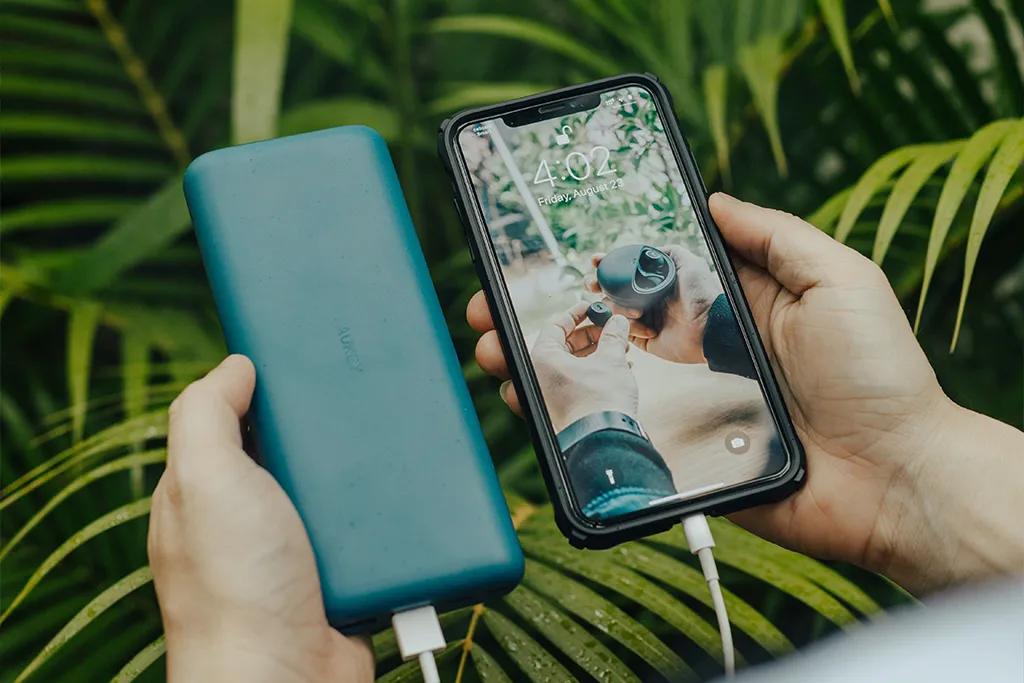
What Size Power Bank Do You Need?
Power bank capacity is usually shown in mAh, which stands for milliamp hours.
In plain English: bigger number, more stored energy.
But bigger also usually means heavier, bulkier and slower to recharge.
For most outdoor use:
- 5,000mAh is good for emergency top-ups
- 10,000mAh is the best all-round size for hiking
- 20,000mAh is better for camping weekends or multiple devices
- 24,000mAh+ is for heavy users, tablets, cameras, laptops or longer trips
For most UK walkers, a 10,000mAh power bank is the sweet spot. It gives enough backup for one or two phone charges without feeling like you’ve packed a brick.
For camping weekends, festivals or phone-heavy trips, go bigger.
Capacity Isn’t the Same as Real-World Charges
A 10,000mAh power bank does not always give a perfect 10,000mAh into your phone.
There are conversion losses, heat, cable loss, device efficiency and real-world nonsense.
So treat charging estimates as rough.
A 10,000mAh power bank might give many modern phones around one to two full charges, depending on the phone, battery size and how you use it.
A 20,000mAh model gives more breathing room, but weighs more.
The best approach is simple: carry more power than you think you’ll need if your phone is doing navigation.
What to Look for in an Outdoor Power Bank
A good hiking or camping power bank should have:
- enough capacity for your trip
- fast charging if your phone supports it
- clear battery indicator
- enough ports for your devices
- low-current mode if charging small devices
- USB-C input and output
- sensible weight
- good build quality
- compatibility with your cables
- some weather protection or a dry bag system
For most people, USB-C matters now. It keeps charging simpler and means you can often use one cable across your phone, head torch, lantern, earbuds and power bank.
The dream is fewer cables, fewer adapters and less rummaging around in the dark muttering at a zip pouch.
1. Anker 313 Power Bank PowerCore 10K — Best Overall Power Bank

The Anker 313 Power Bank PowerCore 10K is the easy all-round pick.
It is simple, compact and has enough capacity for most UK walks, campsites and backup charging. Anker lists it with a 10,000mAh capacity, one USB-C port, one USB-A port and one Micro-USB port. It supports USB-C input and output, which makes it easier to use with modern phones and cables. (anker.com)
Best for: day walks, camping, everyday carry, festivals and general backup power.
Why it earns its place:
- 10,000mAh capacity
- compact size
- trusted brand
- USB-C input and output
- USB-A option
- good all-round value
- simple enough for most people
Possible downside: it is not the fastest or most technical option here, and the Micro-USB port feels dated.
If you want one reliable power bank for normal outdoor use, this is the sensible first pick.
2. Nitecore NB10000 Gen 3 — Best Lightweight Hiking Power Bank
The Nitecore NB10000 Gen 3 is the one for lightweight hikers and wild campers who care about grams.
Nitecore lists the NB10000 Gen 3 as a 10,000mAh power bank with 22.5W fast charging, dual USB-C ports, an IPX5 rating and a weight of around 150g. It uses a carbon fibre composite shell, which helps keep the weight down. (nitecore.com)
Best for: lightweight hiking, wild camping, fast packing and minimalist outdoor kits.
Why it earns its place:
- very light for 10,000mAh
- 22.5W fast charging
- dual USB-C ports
- IPX5 rating
- carbon fibre composite shell
- excellent for lightweight kits
Possible downside: it costs more than basic 10,000mAh power banks.
If you count pack weight but still want proper phone backup, this is one of the strongest choices.
3. INIU B61 10000mAh Power Bank — Best Budget Power Bank

The INIU B61 is a strong budget-friendly option if you want fast charging without spending too much.
INIU lists the B61 with a 10,000mAh capacity, 22.5W fast charging, USB-C input and output, three output ports, and a weight of around 195.6g. It also includes a short USB-A to USB-C cable and travel pouch. (iniushop.com)
Best for: budget hikers, casual campers, everyday carry and phone backup.
Why it earns its place:
- good value
- 10,000mAh capacity
- 22.5W fast charging
- USB-C input and output
- three output ports
- travel pouch included
- lighter than many budget banks
Possible downside: not as outdoorsy or rugged-feeling as the Nitecore.
If you want an affordable power bank that still feels current, this is a very sensible pick.
4. Anker 523 PowerCore Slim 10K PD — Best Slim Power Bank
The Anker 523 PowerCore Slim 10K PD is a good choice if you want a slim power bank that slips into a day bag or pocket more neatly.
Anker lists the 523 Power Bank with one USB-A output port, one USB-C input/output port, dimensions of 5.89 x 2.7 x 0.57 inches, and a weight of 7.5 ounces. (service.anker.com)
Best for: day bags, everyday carry, commuting, travel and slim packing.
Why it earns its place:
- slim design
- 10,000mAh capacity
- USB-C input and output
- USB-A output
- trusted brand
- easier to pack than chunky banks
Possible downside: slim is not always the same as ultralight, and it is less rugged than outdoor-specific options.
If your power bank lives in a day bag as often as a hiking bag, this is a neat middle ground.
5. BioLite Charge 40 PD — Best Camping Power Bank

The BioLite Charge 40 PD is a good camping-focused power bank because it sits in that useful 10,000mAh zone while feeling designed for outdoor and travel use.
BioLite lists the Charge 40 PD with 10,000mAh capacity, USB-C PD fast charging, 2.5 phone charges and FAA carry-on compliance. It is designed for phones, earbuds, tablets and other personal devices. (bioliteenergy.com)
Best for: camping, travel, festivals, campsites and outdoor weekends.
Why it earns its place:
- 10,000mAh capacity
- USB-C PD
- camping-friendly brand
- good for personal devices
- packable shape
- useful weekend size
Possible downside: may cost more than basic power banks with similar capacity.
This is a good choice if you already like BioLite kit or want a power bank that feels more outdoors-focused than a generic charger.
6. Goal Zero Flip 24 — Best Compact Backup Power Bank
The Goal Zero Flip 24 is a compact backup charger rather than a full weekend power solution.
Goal Zero lists the Flip 24 at 4.6oz, with dimensions of 3.7 x 1.63 x 0.83 inches, and a battery size of 24.12Wh. (goalzero.com)
Best for: emergency top-ups, short walks, EDC, travel and backup charging.
Why it earns its place:
- compact
- simple
- easy to carry
- good emergency option
- trusted outdoor power brand
- useful for short trips
Possible downside: lower capacity than 10,000mAh models.
This is the sort of charger that makes sense if you mostly want a safety net rather than a big charging setup.
7. Anker 737 PowerCore 24K — Best High-Capacity Power Bank

The Anker 737 PowerCore 24K is the heavy-duty option.
This is not the power bank I’d carry for a quick dog walk. It is for bigger trips, multiple devices, tablets, cameras, high phone use, longer camps or people who want serious backup power.
Anker lists the 737 Power Bank with 24,000mAh capacity, 140W max output, two USB-C ports, one USB-A port, three outputs, dimensions of 155.7 x 54.6 x 49.5mm, and a weight of 630g. (anker.com)
Best for: camping weekends, multiple devices, tablets, laptops, camera kit and heavy users.
Why it earns its place:
- huge 24,000mAh capacity
- 140W max output
- two USB-C ports
- one USB-A port
- three outputs
- serious backup power
- useful for more than phones
Possible downside: it is heavy. At 630g, it is overkill for many day walks.
If you need big power, this is excellent. If you just want your phone to survive a walk, it is probably too much.
8. UGREEN 10000mAh PD 20W Power Bank — Best Simple 20W Option

The UGREEN 10000mAh PD 20W Power Bank is another sensible everyday outdoor option.
UGREEN lists this 10,000mAh 20W PD power bank at 200g, with dimensions of 13.2 x 6.6 x 1.7cm and a lithium polymer battery. (ugreen.com)
Best for: everyday carry, day hikes, travel and simple phone charging.
Why it earns its place:
- 10,000mAh capacity
- 20W PD output
- 200g weight
- slim-ish size
- good everyday charger
- useful for phone backup
Possible downside: not as lightweight as the Nitecore and not as high-capacity as camping-focused banks.
This is a good straightforward power bank if you want something useful for both walks and normal life.

Best Power Bank for Hiking
For most UK hikes, I’d choose a 10,000mAh power bank.
The Anker 313 PowerCore 10K is the best all-rounder.
The Nitecore NB10000 Gen 3 is better if you care about weight.
The INIU B61 is the better budget pick.
For hiking, avoid huge heavy power banks unless the route, weather or phone use genuinely justifies it. A power bank that is too heavy gets left at home, which makes it impressively useless.
Best Power Bank for Camping
For camping, you can justify more capacity.
A campsite or weekend camp might involve:
- phone
- camping lantern
- watch
- camera
- train tickets
- photos and video
- head torch
- speaker
- earbuds
- kids’ devices
- weather checks
For most camping weekends, the BioLite Charge 40 PD or a good 10,000mAh Anker is enough for simple use.
If you need to charge multiple devices or stay out longer, the Anker 737 PowerCore 24K makes more sense.
Best Power Bank for Wild Camping
For wild camping, I’d choose the Nitecore NB10000 Gen 3 if weight matters, or the Anker 313 PowerCore 10K if you want better value.
A wild camping power setup should be simple:
- phone fully charged before leaving
- compact power bank
- correct cable
- phone in battery saver mode
- offline maps downloaded
- head torch charged
- waterproof pouch for electronics
That is enough for most one-night trips.
You do not need to pack a massive battery unless you are filming, navigating heavily, using multiple devices or staying out longer.

Best Power Bank for Festivals
Festivals are where bigger power banks start making sense.
You may be using your phone for:
- tickets
- photos
- messages
- finding friends
- travel home
- maps
- videos
- payments
- set times
For festivals, I’d choose at least 10,000mAh. For a full weekend, 20,000mAh or more is safer, especially if you cannot easily recharge.
The Anker 737 PowerCore 24K is powerful but heavy. A 20,000mAh mid-range bank may be a better comfort choice for most festival bags.
Also, take the right cable. The wrong cable turns a brilliant power bank into a weighted rectangle of shame.
Power Bank Features That Actually Matter
USB-C Input and Output
This is one of the biggest things to look for.
USB-C makes charging simpler and usually faster.
Weight
For hiking, weight matters.
For campsites, less so.
Battery Indicator
A proper percentage display is nice, but simple LED indicators are fine.
Low-Current Mode
Useful for small devices like earbuds, watches and some head torches.
Capacity
5,000mAh is backup.
10,000mAh is the hiking sweet spot.
20,000mAh+ is for camping, festivals and heavy users.
Fast Charging
Useful if your phone supports it. Look for USB-C PD or similar.
Multiple Ports
Useful if you charge a phone and head torch, or share with someone else.
Weather Protection
Most power banks are not truly waterproof. Keep them in a pouch or dry bag.
How to Keep a Power Bank Dry Outdoors
Power banks and rain are not friends.
Keep your power bank in:
- waterproof pouch
- small dry bag
- zip pouch inside a dry bag
- inner rucksack pocket
- jacket pocket only if properly protected
ipow Waterproof Pouch Bag Case Waist Strap

OEX Drysac Multi Pack

Aquapac Waterproof Phone Case

Do not charge devices in heavy rain unless you have proper protection.
Water in ports is a quick way to turn useful kit into electronic sadness.
How to Make Your Phone Battery Last Longer Outdoors
A power bank helps, but good habits matter too.
Before the walk:
- fully charge your phone
- close battery-hungry apps
- reduce screen brightness
- keep the phone warm in cold weather
- use airplane mode where signal hunting is draining battery
- download offline maps
- turn on battery saver
- switch off Bluetooth if not needed
- keep it dry
- check your cable actually works
Your phone battery often dies faster outdoors because of cold, poor signal, GPS use, screen brightness and constant checking.
Use it deliberately.
Do not keep opening the map every thirty seconds because you are anxious. Stop, check properly, then walk.
Power Bank Mistakes Beginners Make
Buying too little capacity
A tiny emergency charger is fine for short walks, but not enough for a full weekend.
Forgetting the cable
Classic. Annoying. Completely avoidable.
Letting it get wet
Keep electronics protected in a pouch or dry bag.
Ignoring output speed
Some cheap power banks charge slowly. That is annoying when you need power fast.
Buying too much capacity
A huge power bank is heavy. If you leave it at home, it helps nobody.
Not charging the power bank first
A flat power bank is just a heavy lesson.
Relying only on your phone for navigation
Power helps, but map skills and route planning still matter.
Charging in the tent mess
Keep cables organised so you do not roll onto them, bend them or lose them in your sleeping bag.
Simple Power Setups by Trip Type
Short day walk
Carry a compact 5,000mAh backup or small 10,000mAh power bank.
Train-accessible walk
Carry 10,000mAh, especially if using your phone for tickets, maps and travel updates.
Weekend campsite
Carry 10,000mAh to 20,000mAh depending on devices.
Camera or laptop use
Look at higher-output models like the Anker 737 PowerCore 24K.
Full-day hike
Carry a 10,000mAh power bank, correct cable and waterproof pouch.
One-night wild camp
Carry a lightweight 10,000mAh power bank, USB-C cable and dry pouch.
Festival weekend
Carry 20,000mAh or more if your phone use is heavy and charging access is limited.
Flying With Power Banks
Most normal hiking power banks are fine for travel, but battery rules matter.
Power banks generally need to go in hand luggage, not checked luggage, and there are airline limits based on watt-hours.
For typical 10,000mAh power banks, this is usually not an issue. Larger high-capacity banks need more attention.
Check your airline’s latest rules before flying.
For UK walking and camping, this is not usually relevant. For overseas hiking trips, it is.
Final Verdict: Which Power Bank Should You Buy?
If I had to recommend one power bank for most UK walkers and campers, I’d choose the Anker 313 PowerCore 10K.
It is simple, compact and enough for most outdoor phone backup.
If you care about pack weight, choose the Nitecore NB10000 Gen 3.
If you want budget value, choose the INIU B61 10000mAh.
If you want a slim everyday option, choose the Anker 523 PowerCore Slim 10K PD.
If you want something for campsite weekends, the BioLite Charge 40 PD is a good outdoor-friendly pick.
If you need serious capacity, go for the Anker 737 PowerCore 24K.
The main thing is simple: charge it before you leave, pack the right cable, and keep it dry.
A power bank is only boring until your phone is on 3% and your route is still on the screen.
Then it becomes the best thing in the bag.
Power Bank FAQs
What size power bank is best for hiking?
For most hikes, a 10,000mAh power bank is the best balance of capacity and weight. It gives useful phone backup without feeling too bulky in a day bag.
Is 5,000mAh enough for a walk?
A 5,000mAh power bank can be enough for short walks or emergency top-ups. For longer hikes, navigation-heavy days or cold weather, 10,000mAh is a safer choice.
Is 20,000mAh too much for hiking?
For normal day hikes, 20,000mAh is often more than you need and can feel heavy. It makes more sense for camping weekends, festivals, multiple devices or longer trips.
Can I charge a head torch from a power bank?
Yes, many rechargeable head torches can be charged from a power bank if you have the correct cable. Check the head torch’s charging port and bring the cable with you.
Are power banks waterproof?
Most power banks are not fully waterproof. Keep them inside a waterproof pouch, dry bag or protected rucksack pocket, especially on wet hikes and camps.
What is the best power bank for wild camping?
For most one-night wild camps, a lightweight 10,000mAh power bank is ideal. The Nitecore NB10000 Gen 3 is excellent if weight matters, while Anker 10K models are strong value picks.


